

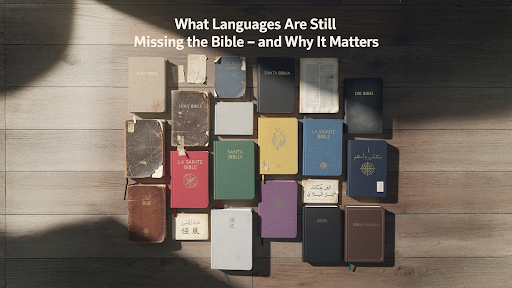
Language shapes how Scripture is understood and lived out, and translation accuracy can be lost when God’s Word is encountered outside a heart language. This is why Christian translation and professional localization services remain essential to fulfilling the Great Commission today.
Specific Languages Still Missing the Bible – and the Challenges Behind Them
Real Christian communities who want access to Scripture are impacted by the fact that the Bible is currently incomplete in over 3,000 languages worldwide. Below are examples of languages where full bible translations remain missing or incomplete.
- Hausa (regional dialects) – many communities still rely on secondary bible versions, limiting consistent teaching.
- Balochi – political restrictions and complex biblical vocabulary slow translation efforts.
- Tshiluba (local variants) – limited written standards require oral-focused localization services.
- Santali – large populations face challenges due to unique words and untranslatable words tied to theology.
- Fulfulde (Fulani dialects) – dialect diversity complicates professional translation and consistent use.
These challenges are rarely about population size. Linguistic complexity and oral communication patterns often affect translation accuracy, which is why Christian translation ministries play a vital role in preserving faithful, understandable Scripture.
When Partial and Oral Scripture Shape Access to the Bible
Access to one Gospel or selected Psalms is not the same as having the full Bible. Partial Bible translations often leave pastors reliant on secondary bible versions, increasing the risk of reduced translation accuracy. In many cases, ministries seeking to localize Christian books or devotionals discover that core Scripture references do not exist in the target language.
For millions of people, the Bible is not read but heard. Oral cultures depend on audio and spoken teaching, making voice-over, overdub, and audio Bible projects essential localization services. At Christian Lingua, we support Christian translation ministries by delivering oral Scripture through audio recordings that require the same level of professional translation as written Bible translations.
Why This Matters for the Global Church
Every untranslated or partially translated language represents real people seeking to engage Scripture with confidence. In our daily work at Christian Lingua, we often find that ministries believe their content is ready, only to discover it depends on bible versions unavailable in the target language, leaving pastors and listeners disconnected.
This is why Christian translation ministries like Christian Lingua exist – to safeguard meaning, doctrine, and tone as Scripture crosses cultures. By navigating untranslatable words and applying professional translation standards, we protect translation accuracy and ensure Scripture remains trustworthy, understandable, and spiritually nourishing in every language it reaches.
Partnering for Greater Impact
At Christian Lingua, we help ministries, authors, and media producers share their message across languages through Christian translation, voice-over, overdub, and ASL interpretation. If your ministry serves a multilingual audience, we would be honored to help you communicate with clarity and care.
Contact Christian Lingua today to discover how language can strengthen your mission and bring Scripture closer to every heart.