

Different Bible Translations Explained: How to Understand the Differences and Choose the Right One
Choosing the best Bible translation is a common question among believers, churches, and ministries. With so many translations of the Bible available today, understanding the distinctions can be confusing, particularly for leaders responsible for teaching, publishing, or distributing God's Word across nations.
- Christian Lingua
This topic is more important now than ever, since global ministry relies on clarity, faithfulness, and accessibility in all languages.
Understanding different Bible translations is not about ranking Scripture, but about properly stewarding it, so that every reader might receive God's truth in clarity and accuracy.
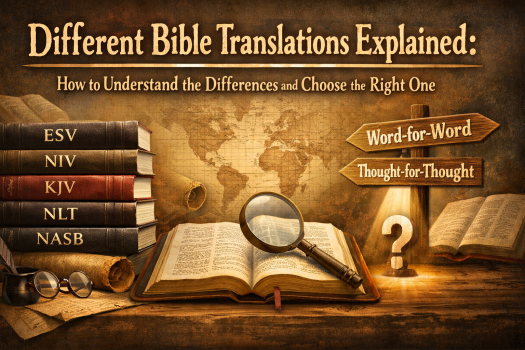
How Many Translations of the Bible Are There?
How many Bible versions are there? Today, Scripture is translated into thousands of languages, with multiple English versions representing various translation philosophies. These different biblical translations exist to serve a variety of audiences, reading levels, and service contexts.
Some translations concentrate on word-for-word accuracy, while others emphasize thought-for-thought clarity. Each strategy has a purpose when implemented correctly.
Translation Philosophy: Why Versions Differ
The fundamental distinctions between Bible translations are based on the translation method:
- Formal equivalency (word-for-word) emphasizes clarity and structure.
- Dynamic equivalency (thought-for-thought) emphasizes readability and flow.
- Functional or paraphrase: emphasizes accessibility for modern readers.
When ministries seek the most accurate Bible translation, experts frequently recommend versions that strike a careful balance between accuracy and readability. This is why disputes about the most accurate Bible translation according to scholars, rarely result in a single answer; it depends on the application.
Choosing the correct balance is important when teaching, studying, outreaching, or producing audio Scripture.
What Is the Most Accurate Bible Translation?
The question of what is the most accurate Bible translation cannot be answered in isolation. Accuracy requires adherence to original documents, theological integrity, and cultural understanding. Many experts believe that translations based on genuine Hebrew, Aramaic, and Greek texts, and vetted by various theological teams, are the most reliable.
For global ministries, accuracy entails ensuring that meaning, rather than just words, is correctly transmitted across languages.
Choosing the Right Translation for Your Ministry
Approaches vary depending on the ministry situation. A Bible used for in-depth theological study may differ from one geared for evangelism, discipleship, or children's ministry.
For example:
- A publishing ministry may require consistency across many languages.
- A media ministry may need spoken-word clarity for voice-overs or overdubs.
- A church serving Deaf communities might prioritize accuracy in ASL interpretation.
Christian Lingua frequently collaborates with ministries to guarantee that the most accurate version of the Bible is preserved when translating books, sermons, and Scripture-based media into other languages.
Language and the Great Commission
The Great Commission instructs believers to spread the Gospel to all nations. Language is not a barrier; it is a bridge. Faithful Bible translation allows churches, authors, and media producers to reach hearts while maintaining theological depth and spiritual value.
When Scripture is carefully translated, it becomes accessible, trustworthy, and transforming in whatever culture it reaches.
Partner With Christian Lingua
Understanding the different Bible translations is the first step. The objective is to ensure their faithful translation into new languages. Christian Lingua exists to assist ministries in communicating God's Word with accuracy, reverence, and cultural sensitivity via translation, voice-over, overdub, and ASL interpretation.
If your ministry is ready to broaden its reach and preserve biblical truth across languages, work with Christian Lingua to help you serve the worldwide Church with excellence.