

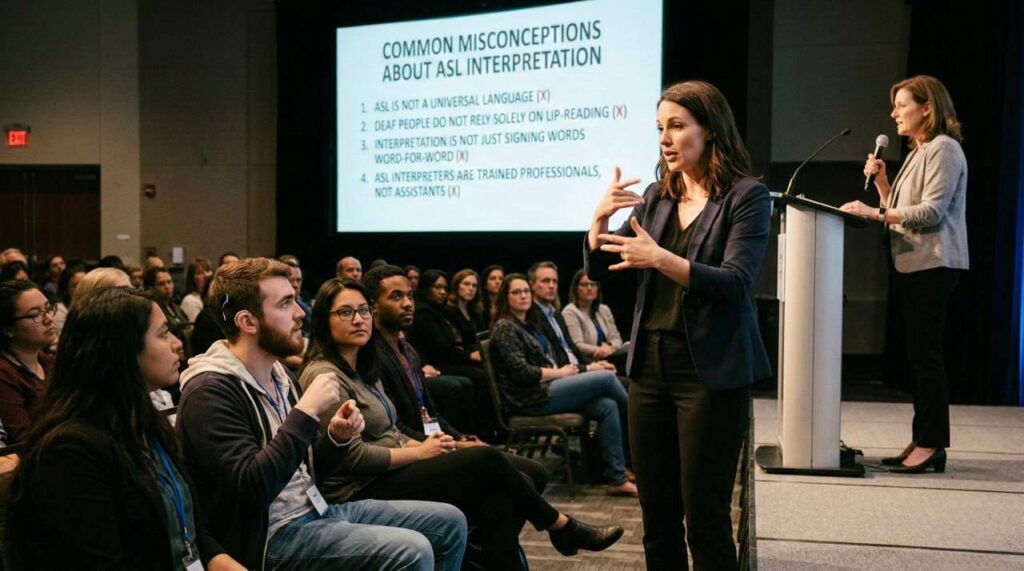
The Myth of Word-for-Word Transfer
American Sign Language is not signed English. It is not a manual overlay placed upon spoken syntax. American Sign Language possesses its own grammar, spatial architecture, and embodied lexicon. Treating it as a direct substitute for sound fractures meaning at the root. Doctrine does not survive mechanical exchange.
Many churches assume interpretation means to translate materials from one form into another. That assumption weakens theological precision. ASL operates through classifiers, facial markers, and spatial referencing that function as structural grammar. Remove those elements and the message loses alignment. A sermon may remain emotionally stirring, yet doctrinal clarity can erode in subtle ways.
Accuracy is not decorative. It is structural.
The Illusion of Universality
Another misconception insists that sign language is universal. It is not. American Sign Language differs from other national sign systems in vocabulary, syntax, and cultural framing. Each grows from distinct community soil.
When ministries expand through media distribution yet overlook Deaf audiences, a silent boundary remains. Effective Church interpreter services require more than availability. They demand cultural literacy and theological understanding. A qualified Church interpreter must grasp both doctrinal vocabulary and the interpretive habits of the Deaf community.
Language detached from culture becomes distortion.
Interpretation Is Not Performance
Expressive movement alone does not equal competence. Interpretation within faith contexts carries weight. Facial grammar in ASL signals conditional clauses, emphasis, rhetorical force. A misplaced expression can alter intent. A softened marker can blur warning into suggestion.
This is why trained christian translators with theological formation remain essential. Precision protects meaning. Emotional energy cannot replace structural fidelity.
Deaf Ministry Is Not Secondary
ASL interpretation is often treated as peripheral, placed to the side of the platform, funded as an afterthought. The Great Commission does not privilege sound over sight. The mandate extends to every language system through which the gospel is received.
Christian lingua operates as a disciplined Christian lingua translation agency, preserving doctrinal integrity across linguistic frontiers. Through Christian translation services and specialized expertise, the organization bridges the gap between spoken proclamation and the Deaf believer’s heart language. The goal is not approximation. It is alignment.
The mission field includes the front row. Every sermon carries consequence. Ensure that proclamation remains intact across every vernacular and every visual grammar. Visit Christian Lingua and secure interpretation that honors both message and mandate before distortion takes root.