

Will AI Replace Translators?
- Christian Lingua
Will AI Replace Translators? A Look Into the Future of Language Services
In an era where AI is taking over many different jobs, some professionals are still wondering if they are next. AI has advanced by leaps and bounds since it first came on the scene. Many professions and jobs have been replaced by technology which has left others with many questions. One such case is that of translators. Will their jobs be replaced in the future by AI technology? Let’s take an honest look at that question.
Benefits of AI in Translation
With the rise of AI services such as Google Translate, ChatGPT, and DeepL, people are wondering where it will go in the world of translating languages. The services are continually advancing and progressing as the technology can be programmed and trained for any field it is being used in. There are benefits to using AI when translating languages such as offering translation services to businesses to work with customers when a translator is not around, correctly identifying the language being spoken, and it is cost-effective. These benefits can help businesses, travelers, and others to understand the basics of language between two parties.
Downsides to AI Translation
While the benefits of AI can mean immediate connection in some instances, there are downsides as well to this technology. Check out these four ways that AI is at a disadvantage:
- Lack of Context - For starters, Ai cannot understand the context. Take the Bible as a primary example. When using AI to translate the Bible, it cannot go back and check what the Old Testament has to say to help provide the context of a story. There are many different aspects of stories that are laid out in the Old Testament that AI simply cannot take into account when translating.
- Lack of Creativity - AI does not have the creativity ability that a human translator can. AI also will not have a natural flow of language and conversation that a human translator can provide. There truly is something different in a conversation between computer and person versus person to person. Consider a conversation you have with a friend. There are many different ways to describe experiences that can help bring the listener into the story with you. AI simply doesn’t have that ability.
- Lack of Research - Another disadvantage to having AI versus human translation is that AI cannot do research itself. It can only provide the information that it already has programmed. Because of this lack of research, AI cannot determine the best translation for specific words. When translating a Bible to another language, a person can determine which version is best for helping to get the message across to others who don’t speak the same language. The person working with other cultures can do extensive research to help determine the best version of the Bible to reach other cultures with the proper message.
- Lack of Cultural Sensitivity - Yet another downside to AI translation services is that AI does not have cultural sensitivity. Cultural idioms, Christian denominations, and other cultural tendencies are not understood by It also cannot determine someone’s educational background so it can be more technical than is understood by those with a lack of training in certain areas.
Partner Together
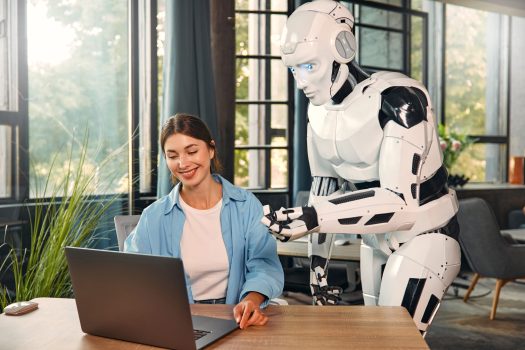
The best news is that AI doesn’t take over human translation but is used as a tool to help provide an unparalleled experience. Partnering together with human translation and AI technology can ensure that the message has been given in a way that any culture can understand. This allows the creativity, research, and sensitivity that humans bring to combine with the knowledge and learning that AI brings to the table. In most cases, translators see this as a very beneficial tool rather than something out for their job.
The good news is that AI will not be taking over anytime soon. The success and future of translation lie in humans and AI working as a unit to help provide better communication around the world.
Human translators will never be obsolete. No matter how much advancement happens in technology, there are still things that computers can’t learn.
However, success will depend on the ability to adapt and collaborate on the human side of things. In the ever-evolving landscape of technology, seeing AI options as a partner versus a competitor will be how it continues to move forward. When considering that option, the future of the translation industry is a very bright, very human landscape that is waiting for more connections between humanity itself.